Air conditioning and pressurization
One pack and a trim air system condition bleed air from the engines or the APU. The crew selects the bleed sources. Two IASCs control the valves, the temperature and the cabin pressure, and watch for leaks.
Open the slidesWhere the air comes from
Bleed air and air conditioning
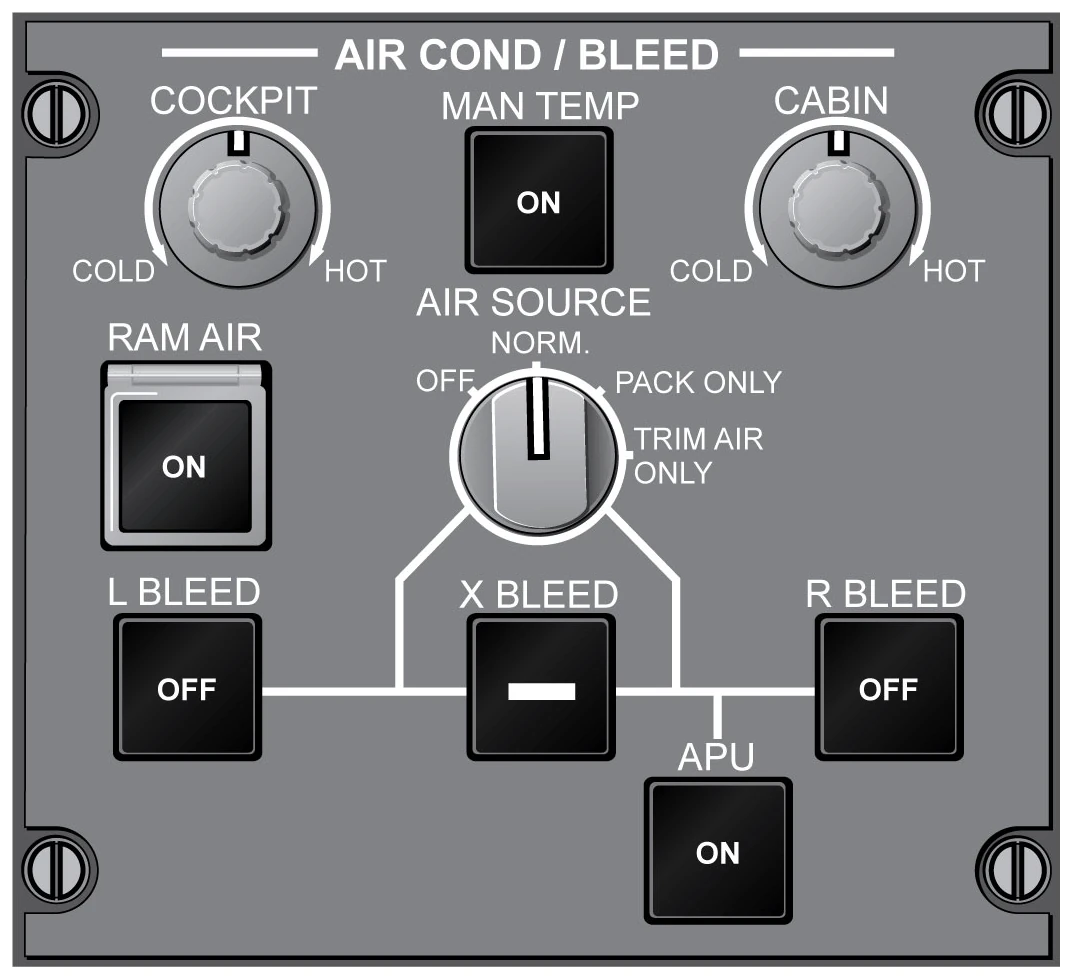
- One bleed manifold, split left and right by the XBLEED valve. Each engine feeds its own side. The APU and a ground cart feed the right side only.
- Intermediate pressure (IP) bleed, limited to 50 ± 3 psi, feeds the air conditioning. High pressure (HP) bleed feeds wing anti-ice.
- The pack cools the air to just above freezing. Hot trim air is mixed in to reach the selected temperature, with separate control for cockpit and cabin.
- If the pack is lost completely, trim air alone gives backup pressurization and temperature control.
- Selecting L or R STARTER to START opens the XBLEED valve and closes the flow control valves, so the bleed air goes to the starter. At self-sustaining speed they return to their previous position.
- All bleed switching is manual. Takeoff and landing are normally flown on APU bleed with the engine bleeds OFF.
| COCKPIT and CABIN knobs | Automatic range 15 °C to 35 °C |
|---|---|
| MAN TEMP ON | Range 10 °C to 70 °C. For when automatic control fails. |
| AIR SOURCE NORM. | Both sides of the manifold feed the pack and trim air. |
| AIR SOURCE PACK ONLY | All the air goes through the pack. Used after a trim air failure. |
| AIR SOURCE TRIM AIR ONLY | All the air goes through trim air, so it is warm. Used after a pack failure. |
| AIR SOURCE OFF | Both flow control valves closed. No bleed air reaches the cabin. |
| RAM AIR (guarded) | Outside air for ventilation at low altitude, unpressurized, when the pack and trim air have both failed. |
How the cabin is held
Pressurization
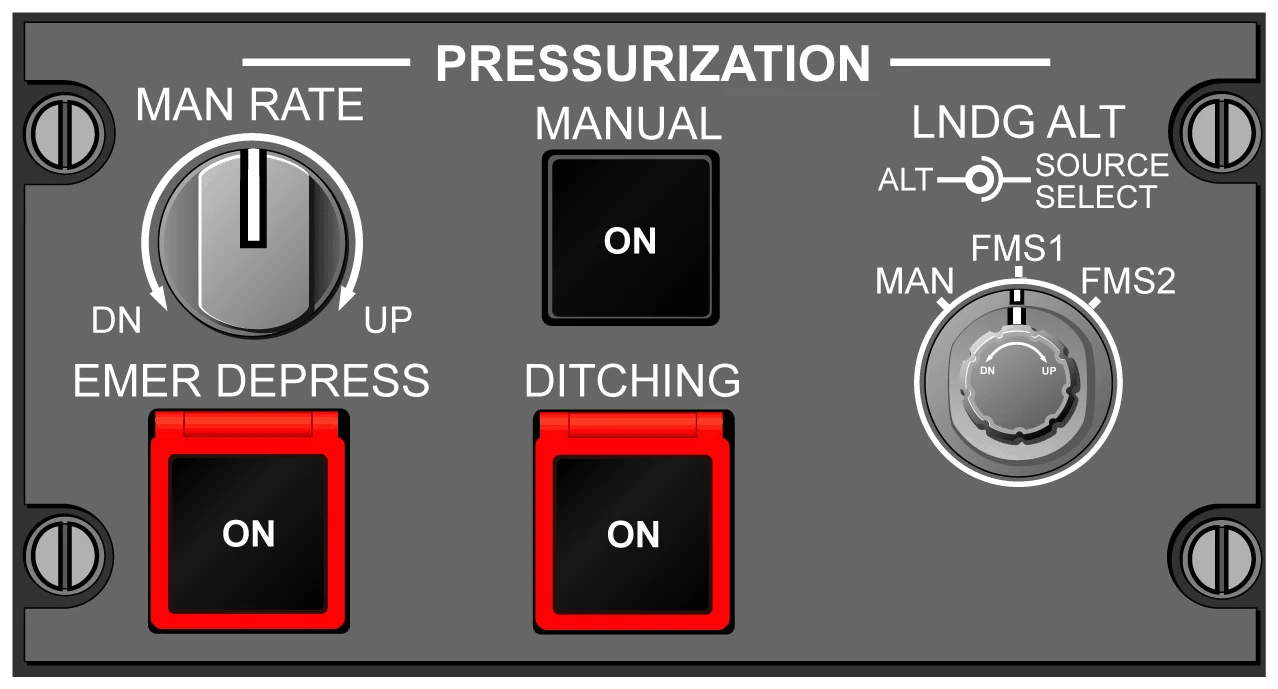
- The outflow valve, on the bottom of the fuselage, sets cabin pressure by controlling how much air leaves.
- Two automatic modes, one in each IASC. One is active and the other stands by. If the active one fails, the other takes over by itself. If both fail, AUTO PRESS FAIL comes on and the crew controls the cabin in manual mode.
- The manual mode drives the outflow valve through its own motor, from the MANUAL switch and the MAN RATE knob.
- Two safety valves on the aft pressure bulkhead relieve overpressure and negative pressure, whatever mode is in use.
- In auto the FMS sends the landing elevation. When the thrust levers go forward for takeoff, the cabin pre-pressurizes to 300 ft below field elevation. On a return soon after takeoff, the cabin descends to the takeoff altitude and the landing elevation does not need a reset.
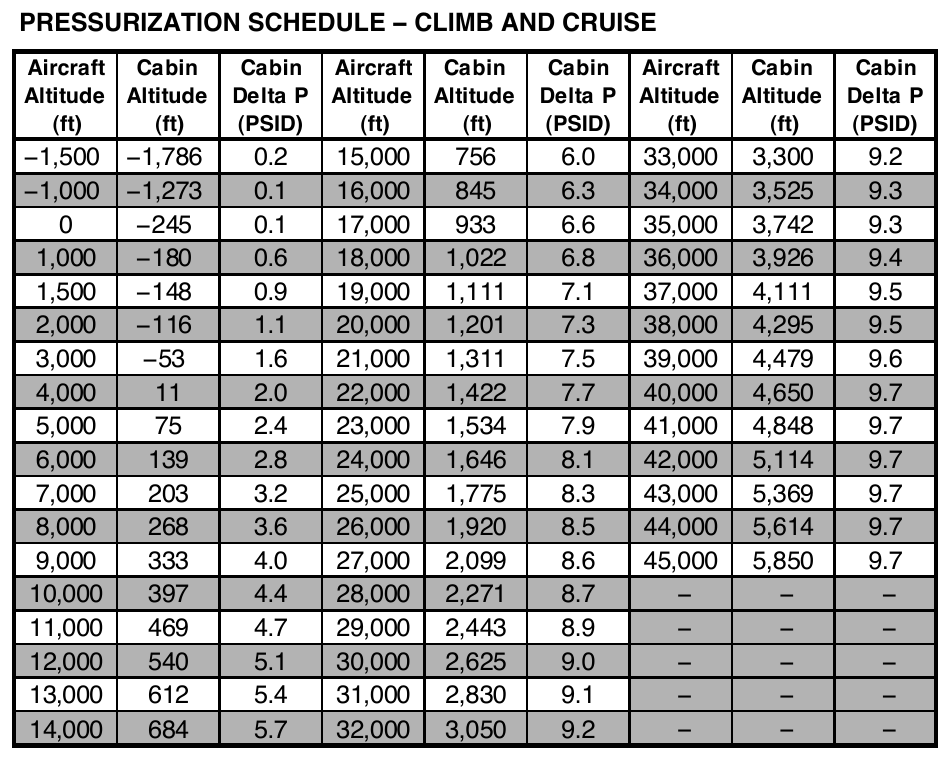
- In climb and cruise the cabin follows the schedule. In descent it aims for about 300 ft below landing elevation. After landing it depressurizes at 500 slfpm and the outflow valve opens fully.
| MAN RATE (manual mode) | UP raises cabin altitude, DN lowers it, the centre holds it. 2,500 slfpm maximum. |
|---|---|
| LNDG ALT | FMS1 or FMS2 takes the landing elevation from the FMS. On MAN the inner knob sets it. |
| EMER DEPRESS (guarded) | Depressurizes the cabin to clear smoke and fumes. Works in auto and manual. |
| EMER DEPRESS target, auto | 14,000 ± 100 ft, or aircraft altitude if lower |
| EMER DEPRESS target, manual | 14,500 ± 500 ft, or aircraft altitude if lower |
| DITCHING (guarded) | For a water landing: depressurizes, shuts off the air conditioning, then keeps the outflow valve closed. Inhibited above 15,000 ft. Not available in manual mode. |
What not to exceed
Limits and abnormals
| Maximum positive ΔP | 10.1 psi |
|---|---|
| Maximum negative ΔP | −0.5 psi |
| Maximum normal ΔP (do not exceed in manual mode) | 9.7 psid |
| Maximum ΔP during landing | 1.0 psi |
| Maximum ΔP on the ground (taxi) | 0.1 psi |
| CABIN ALTITUDE caution | 8,500 ft |
| CABIN ALTITUDE warning (aural "CABIN ALTITUDE") | 9,400 ft |
| APU bleed, for engine start or air conditioning | 20,000 ft maximum |
| AIR SOURCE TRIM AIR ONLY on the ground | Not allowed |
| Pack on the ground | Must run if electrical power has been on for more than 30 minutes with OAT above 40 °C |
| Cabin altitude at 45,000 ft (schedule) | 5,850 ft |
- For a takeoff or landing above 7,850 ft, the CABIN ALTITUDE caution rises to field elevation + 650 ft and the warning to field elevation + 1,550 ft, both capped at 14,300 ft. CABIN ALT WARN HIGH shows the raised limits.
- The IASCs watch the bleed, pylon, pack and trim air ducts for leaks, fully automatically. A leak gives L (R) BLEED LEAK, L (R) PYLON BLEED LEAK, PACK LEAK or TRIM AIR LEAK.
The full module
The slides take you through the bleed air, the pack, the pressurization and the abnormals, then a 10-question test.
Open the slides