Challenger 350 spoiler stuck at 7 degrees on approach, Dublin 2017
Final reportFlight controlsDay
The short version
On the approach to Dublin the crew stowed the speed brakes and got a spoiler fault caution. The right outboard multi-function spoiler had come back up to about 7 degrees and stayed there. The QRH called for Vref +8, 133 kt. At that speed with flap 30 the commander had trouble holding the wings level, so he flew the approach at about 160 kt and landed normally.
What happened
9H-VCJ leaves Riga on a positioning flight to Dublin with three crew.
Descending toward 1,500 ft on a 245 heading for the runway 28 ILS, ATC asks for 180 kt. The commander, who is pilot flying, extends the flight spoilers.
At 15.3 NM the spoiler lever goes back to zero. One second later the right outboard multi-function spoiler re-extends to 7.6 degrees, then settles at about 7. A spoiler fault caution appears on EICAS and the synoptic shows the right outboard spoiler. The autopilot holds about 10 degrees of left wheel to keep the wings level.
Flap 10 at 13.5 NM, localiser capture at 10.2 NM, flap 20 at 9.3 NM. The crew run the Spoilers Fault checklist. With a flap 30 Vref of 125 kt, their target is 133 kt.
The autopilot is disconnected at 6.5 NM. The commander's wheel inputs grow to about 18 degrees either way.
Flap 30 is selected at 4.77 NM. As the speed drops toward 133 kt, the wheel inputs grow sharply and peak at 80 degrees left and 35 degrees right. The commander increases speed to just under 160 kt and tells ATC he will need more runway than usual.
Touchdown on runway 28.
All times are local, which was also UTC.
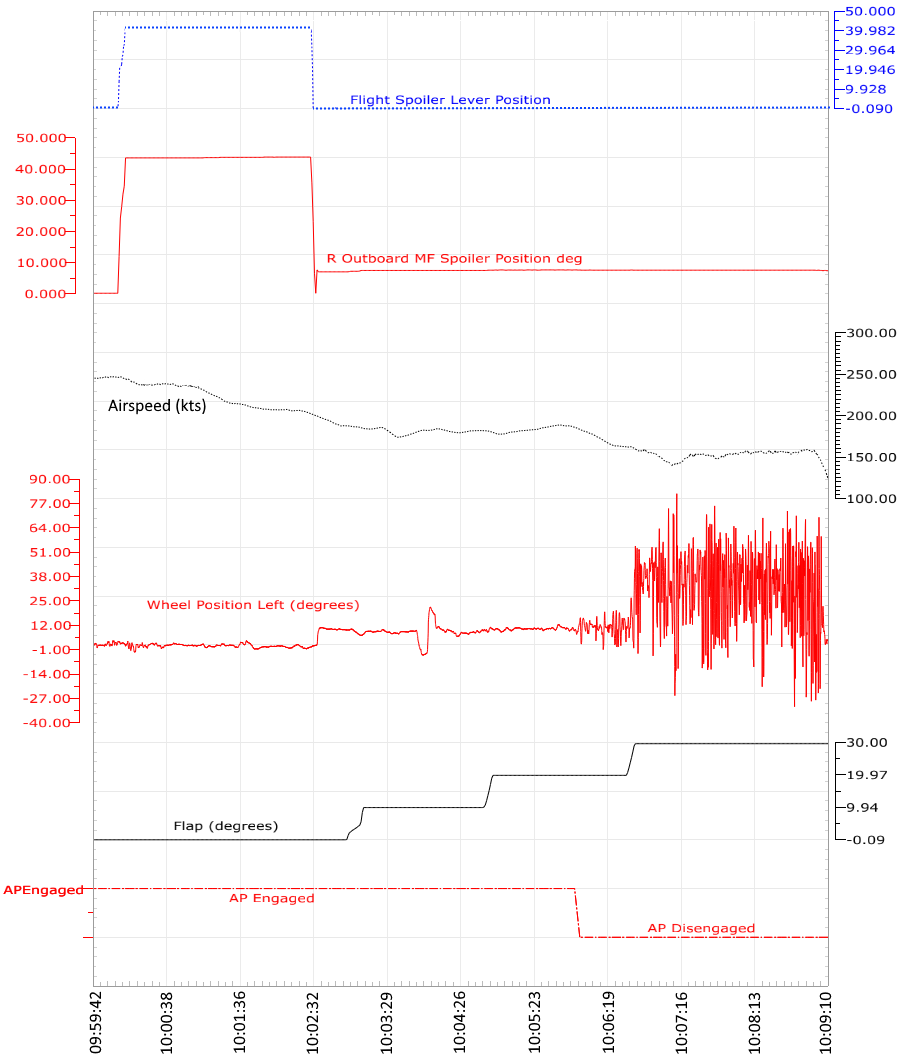
The commander described the roll control as having "two stops" on the wheel. There seemed to be a lag between his left input and the response. Then the aircraft rolled too far left and he had to come back right, which set up a pilot-induced oscillation. He thought about declaring a PAN. The aircraft was controllable at 160 kt, so he did not, and he flew a normal landing.1
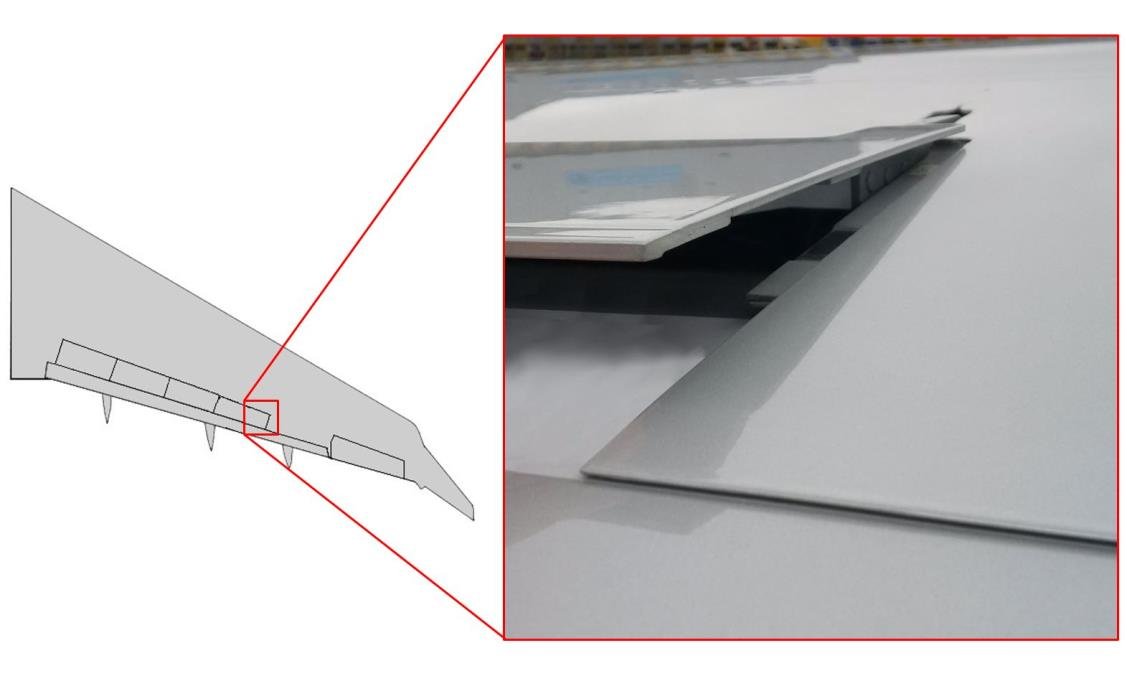
After shutdown he photographed the spoiler, still standing proud of the right wing. The cockpit voice recorder could not help the investigation. The aircraft stayed on electrical power while parked, and the recorder recorded over the flight.1
Why it happened
The report gives the probable cause as roll control difficulty on the approach. The right outboard multi-function spoiler had deployed without a command, most likely because of a wiring or connector continuity fault, and then stayed at seven degrees. The contributory cause was the QRH. The guidance at the time on approach speed and flap after a multi-function spoiler fault did not allow for a spoiler held at an intermediate position.1
The system did what it was designed to do. It detected the uncommanded movement and stopped the panel at about 7 degrees instead of letting it go to full deflection. It then shut off hydraulics to both outboard spoilers and left roll assist to the inboard pair.
Ground rig tests reproduced the event. An open circuit in the excitation supply to the spoiler actuator's position sensor drove the panel up from stowed. The aircraft had logged the same sensor message several times in the week before the flight, during ground operations. The fault did not come back after the aircraft was returned to service, and the wiring or connector problem was never pinned down.
The certification flight tests for a jammed spoiler used an outboard panel stuck at full deflection, 45 degrees. That was taken as the critical case because it needs the most control input. Behind a panel at 45 degrees the airflow most likely stays separated, so the correction is steady. Behind a panel at 7 degrees, with flap past 20, the airflow over the flap probably separated and reattached in turns. Lift on the right wing would then come and go. Control inputs chasing it could lead to pilot-induced oscillation, especially at low speed, and the flight data showed this.
The AAIU made no safety recommendations, because the manufacturer had already acted. Bombardier ran ground rig, simulator and flight tests and changed the AFM procedures for spoiler failures in flight (Challenger 350 AFM revision 21, Challenger 300 revision 55). The changes cover Spoilers Fault, Roll Spoiler Fail, Spoiler Fail, and Flap and Spoiler Fail, and alter both the flap setting and the Vref additive when a spoiler is stuck fully or partly extended. Transport Canada made them mandatory with AD CF-2019-29, effective 26 August 2019.3
What a crew can take from it
A small stuck surface can be harder to fly than a big one. The certification case was a spoiler stuck at 45 degrees, and it gives a steady roll that you can hold with the wheel. At 7 degrees with landing flap, the lift on that wing most likely came and went. If the roll gets worse as you add flap or slow down, believe it, even if the checklist speed says otherwise.
Look at what the autopilot is holding before you take over. Here the wheel sat about 10 degrees left from the moment the spoiler came up. That told the crew the aircraft had a roll asymmetry before anyone touched the controls. Before you disconnect, brief who flies, which way the aircraft will roll, and what speed you will accept.
Speed is a control. At 133 kt with flap 30 the aircraft was difficult to control in roll. At just under 160 kt it was manageable. If you have to fly faster than the checklist speed, tell ATC, as this crew did, and work out whether the runway is long enough at the new speed.
A caution that usually clears may not clear this time. The commander was not surprised by the spoiler fault message and expected it to clear in a few seconds. The aircraft had also logged the same fault message several times on the ground in the week before. Write up spoiler messages even when they reset on their own.
After a serious incident, protect the recorders. The aircraft was left powered on the stand and the cockpit voice recorder recorded over the flight. Follow your operator's procedure for the CVR circuit breaker once the aircraft is parked.
Study it on the course
Sources
- Air Accident Investigation Unit, Ireland. Final Report 2019-012, Serious Incident, Bombardier BD100 1A10, 9H-VCJ, Dublin Airport, 15 January 2017. Published 21 November 2019.
- AAIU, report page.
- Transport Canada, Airworthiness Directive CF-2019-29 (reproduced as Appendix A of the AAIU report).
- Aviation Safety Network, occurrence 230822.
Last updated 22 October 2026
For study only. Always use the approved AFM, QRH and operator procedures.